
Executive Summary
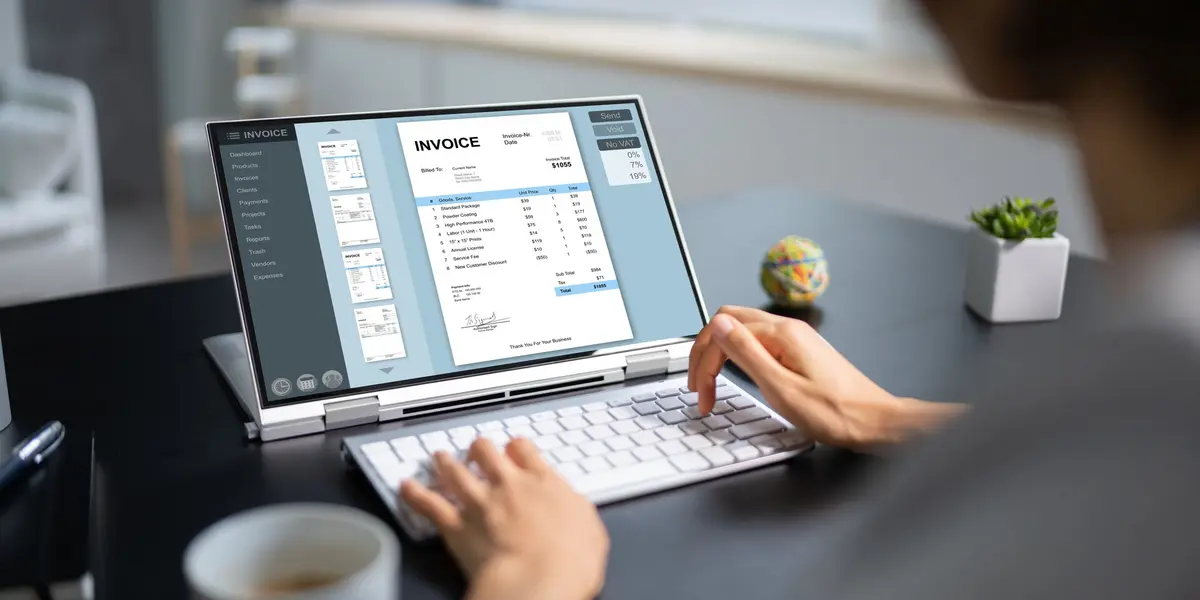
A freelance invoice template is a reusable document that turns finished work into a clear, professional request for payment. A complete one carries the freelancer’s business details, the client’s billing details, a unique invoice number, the issue and due dates, an itemized list of services with rates, the totals with any tax, and the payment terms. Getting these fields right matters more than the design, because late payment is the norm rather than the exception for independent workers. This guide lists every required field, supplies a copy-paste fill-in skeleton, walks through a completed example, and adapts the format for writers, graphic designers, photographers, and hourly contractors. It closes with the tactics that move money in faster: shorter terms, upfront deposits, clear due dates, and a written late-fee policy.
What should a freelance invoice template include?
A freelance invoice template should include nine elements: the freelancer’s contact details, the client’s details, a unique invoice number, the issue and due dates, itemized services, the subtotal and tax, the total amount due, the payment terms, and a short notes line. Miss one and the client’s accounts team has a reason to delay.
- Business and contact details. Name or business name, email, phone, and a logo if one exists. This tells the client who to pay and who to ask.
- Client details. The official company name, the billing contact, and the billing address. Invoices sent to the wrong inbox stall for weeks.
- Invoice number. A unique, sequential code such as ACME-001 or 2026-014. It is how both sides track what is paid and what is open.
- Issue date and due date. The date the invoice was sent and the exact date payment is expected. A real date beats a vague “Net 30” with no anchor.
- Itemized services. One line per deliverable, with a short description, the quantity or hours, and the agreed rate.
- Subtotal, tax, total. The subtotal, any applicable sales tax, and a clearly bolded final total.
- Payment terms. Accepted methods (bank transfer, card, payment link) and the payment window, such as Net 15.
- Late-fee policy. A short line stating the fee for overdue balances, for example 1.5% per month.
- Notes line. A thank-you, the project name, or a reference to the signed agreement.
Completeness is not busywork. The Freelancers Union surveyed more than 5,000 independent workers and found that 71% struggle to collect payment at least once in their careers, losing an average of nearly 6,000 dollars a year. A clear, complete invoice removes the easy excuses that turn a single missed payment into a chronic one.
The real cost of getting invoicing wrong
How often nonpayment hits independent workers, by share affected and income lost
Insight: Most freelancers hit a payment problem at some point, and nonpayment alone erases about 13% of the average affected worker’s annual income.
How does a freelance invoice template work, line by line?
A freelance invoice template works by giving every payment detail a fixed home, so the same skeleton can be reused for every client. Filling it out is a matter of dropping today’s numbers into labeled slots. Here is a simple freelance invoice template ready to copy:
INVOICE

From:                          Bill to:
[Your name / business]         [Client company]
[Email]  [Phone]               [Billing contact]
[Address]                      [Billing address]

Invoice number: [2026-014]
Issue date:     [21 Jun 2026]
Due date:       [05 Jul 2026]   (Net 14)

------------------------------------------------
Description            Qty/Hrs   Rate     Amount
------------------------------------------------
[Service line 1]        [10]    [$90]    [$900]
[Service line 2]         [4]    [$90]    [$360]
------------------------------------------------
                            Subtotal:   [$1,260]
                            Tax (0%):       [$0]
                            TOTAL DUE:   [$1,260]
------------------------------------------------

Payment terms: Net 14. Bank transfer or card.
Late fee: 1.5% per month on overdue balances.
Notes: Thank you. Ref: signed SOW dated 02 Jun 2026.
Two lines cause the most confusion. The invoice number should follow one scheme and never repeat, since duplicate numbers make bookkeeping and tax filing harder. The due date should be an actual calendar date, not just a terms label, because “Net 14” printed without a date invites the client to start the clock whenever it suits them.
A completed freelance invoice example
A filled-in invoice for freelance work makes the skeleton concrete. Below is a sample from a graphic designer billing a small agency for a logo and a one-page website mockup, charged at a blended project rate.
| Field | Entry |
|---|---|
| From | Jordan Lee Design, jordan@example.com |
| Bill to | Northwind Agency, accounts@northwind.example |
| Invoice number | NW-2026-031 |
| Issue date | 21 Jun 2026 |
| Due date | 05 Jul 2026 (Net 14) |
| Logo design package | 1 x $1,200 = $1,200 |
| Landing page mockup | 1 x $800 = $800 |
| Subtotal | $2,000 |
| Tax | $0 |
| Total due | $2,000 |
| Payment terms | Net 14, bank transfer or card |
| Late fee | 1.5% per month after due date |
The same layout holds whether the work is one flat fee or a dozen hourly lines. What changes between fields is the description of the deliverable and how the rate is expressed, which is covered further down.
How can freelancers get paid faster?
Freelancers get paid faster by shortening terms, asking for a deposit, printing a hard due date, offering instant payment methods, and stating a late fee in advance. Each one removes a reason to stall. The math is simple: a Net 14 invoice with a deposit already collected carries far less risk than a Net 30 invoice sent on trust.
Speed matters because slow payment is the baseline, not the exception. Atradius reports that roughly half of business invoices in the United States are paid late, and overdue invoices land an average of 20 days past their due date. For a solo operator, that gap is the difference between covering the month and dipping into savings.
What actually happens to business invoices
Share of US B2B invoices paid on time, paid late, or written off as bad debt
Insight: Half of US business invoices are paid late and roughly 8% are never collected, so terms and follow-up are part of the job.
Five tactics carry most of the weight:
- Use shorter terms. Net 14 or Net 7 gets cash in sooner than the default Net 30, and most clients accept it without comment.
- Collect a deposit. A 30% to 50% upfront payment, agreed in the contract, removes the worst-case loss before the work starts.
- Print a hard due date. An exact date beats a terms label, and it gives a clear trigger for follow-up.
- Make paying easy. Include bank details and a card or payment-link option so the client never has to ask how.
- State the late fee. A line such as 1.5% per month, set before the invoice ships, gives the polite follow-up real weight.
Payment terms belong in writing before the work begins, which is why a signed freelance contract does more for cash flow than any invoice tweak. The invoice only restates what the agreement already promised.
Which invoice template fits each freelance field?
The core invoice template fits every field, and only the line items and rate format change by trade. A writer bills differently from a photographer, but both use the same skeleton of details, dates, and totals.
Freelance writers
A freelance writer invoice template usually lists work per piece or per word: one line per article, blog post, or page, with the rate and the agreed count. Writers on retainer add a single monthly line instead. A reference to the brief or word-count cap keeps revisions from blurring the bill.
Graphic designers
A freelance graphic design invoice template leans on package or project lines: logo suite, brand kit, or landing page mockup, each as a flat fee. Designers often add a line for extra revision rounds beyond the agreed scope, billed at a stated rate so scope creep has a price.
Photographers
A freelance photographer invoice template tends to combine a session or day rate with separate lines for deliverables: edited images, prints, or usage and licensing rights. Travel and expenses get their own lines so the creative fee stays clean and easy to read.
Hourly and contractor freelancers
A freelance hourly invoice template shows each task with hours and an hourly rate, then sums them into the subtotal. A freelance contractor invoice template adds the same structure plus any agreed materials or pass-through costs. Self-employed freelancers should keep every issued invoice on file, since the IRS treats them as core records for self-employed income at tax time.
Where does invoicing fit in the freelance document workflow?
The invoice is the last document in a four-step client workflow: proposal, contract, intake, then invoice. Each one feeds the next, and a clean handoff between them is what makes the final bill uncontested. Skip the early documents and the invoice becomes the first place terms are written down, which is exactly where disputes start.
The sequence is straightforward. A freelance proposal sets scope and price. A signed contract locks payment terms and the late-fee policy. A client intake form gathers the billing contact and address that the invoice needs. By the time the invoice goes out, every number on it has already been agreed.
FlowEdge handles the documents that come before the invoice. It generates proposals, statements of work, and contracts from plain language inputs in minutes, pulling from a freelancer’s own profile and notes rather than generic boilerplate. Getting those right is what gives the closing invoice its terms, its due date, and its late-fee clause.
Frequently Asked Questions
What should a freelance invoice look like?
A freelance invoice should look clean and complete: the freelancer’s details at the top, the client’s details below, then a unique invoice number, issue and due dates, itemized services with rates, and a bolded total. Payment terms and accepted methods sit at the bottom. Clarity matters more than design, since the goal is to give the client no reason to delay.
What are the three types of invoices?
The three most common freelance invoice types are the standard invoice (sent after work is done), the recurring invoice (a fixed amount billed on a schedule, common for retainers), and the deposit or proforma invoice (a request for partial payment before work starts). Many freelancers use all three across different clients.
How should freelancers number their invoices?
Freelancers should use a single, sequential numbering scheme that never repeats, such as 2026-001, 2026-002, or a per-client prefix like ACME-001. Consistent numbers make it easy to track which invoices are open and which are paid, and they keep bookkeeping clean at tax time.
How long should a freelancer wait before chasing an unpaid invoice?
A short, friendly reminder on the due date itself is reasonable, followed by a firmer note three to seven days later. Since overdue business invoices land an average of 20 days past due, early and steady follow-up is normal practice, not pushiness. A pre-stated late fee makes those reminders carry more weight.
Can a freelance invoice be sent as a Word or Google Docs file?
Yes, though most freelancers export the final invoice to PDF before sending. A PDF locks the layout and numbers so they cannot be changed in transit, and it looks more professional than an editable document. The underlying template can still live in Word, Google Docs, or a spreadsheet.
Should freelancers charge a late fee?
A late fee is worth including when it is agreed in the contract first, with a common rate around 1.5% per month on overdue balances. Stating it on the invoice signals that the due date is real. For high-value or complex arrangements, confirming the policy with a professional is sensible before relying on it.